
As manufacturing operations grow, storage needs almost always grow faster.
New products, more SKUs, additional spares, higher service levels—inventory expands, and it has to live somewhere. In many facilities, that growth pushes storage outward across the floor, gradually consuming space that was originally intended for manufacturing, assembly, staging, or work-in-process.
High-density vertical storage changes that trajectory.
By combining dense storage design with unused vertical space, solutions like Vertical Lift Modules (VLMs) and vertical carousels allow facilities to scale inventory without expanding the building—while improving picking accuracy and speed, ergonomic safety, and inventory control at the same time.
This is not just a smart use of space. It’s a smart operational decision.
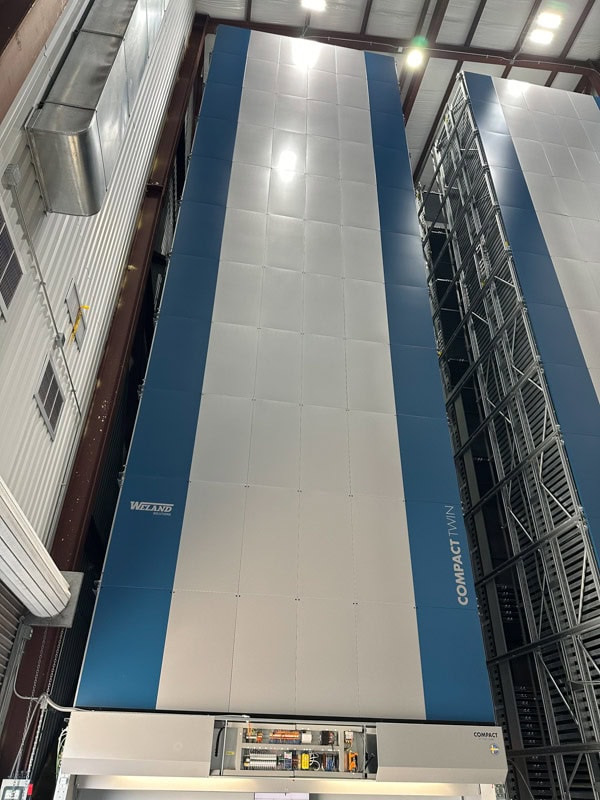
High-density vertical storage changes how work actually gets done
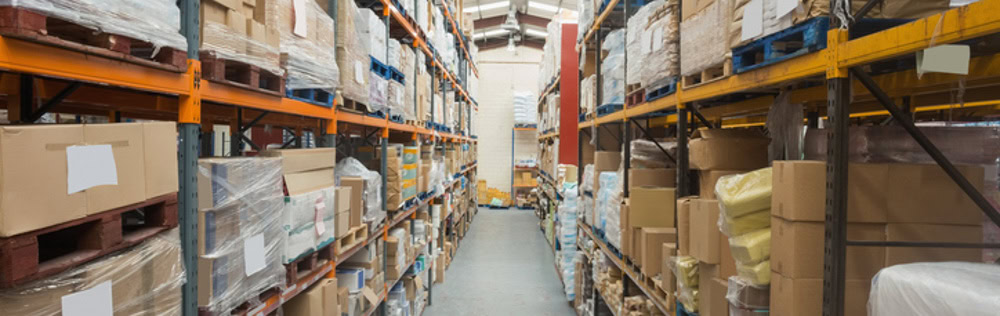
Traditional storage spreads horizontally. As it grows, people walk farther, search longer, reach higher, bend lower, and rely more on memory and workarounds. Over time, accuracy slips, access slows, and physical strain increases—even if the storage itself technically “fits.”
High-density vertical systems behave differently because they are designed around controlled, software-driven access, not just capacity.
Inventory is stored densely, but it is also:
- Precisely located and system-managed
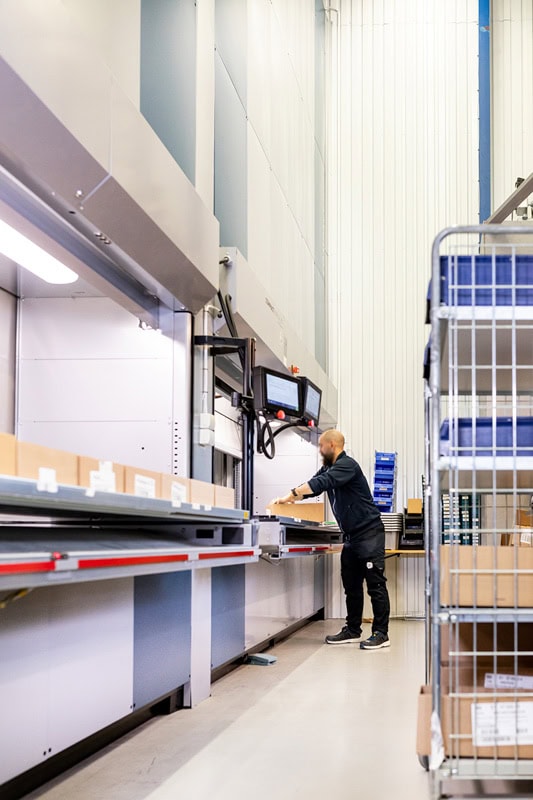
- Delivered directly to the operator
- Presented at a consistent, ergonomic working height
- Is vaulted to keep components safe
Operators don’t search aisles. They don’t climb or overreach. They don’t rely on tribal knowledge to find parts. The system brings the correct inventory to the access point, every time.
As storage grows taller and denser, accuracy, speed, and ergonomic safety are preserved by design, rather than degraded by growth.
Using height and density to protect manufacturing space
In many facilities, expansion decisions are driven less by production growth than by storage pressure. As inventory spreads across the floor, manufacturing space is slowly displaced—not because output increased, but because storage had nowhere else to go. For a deeper look at how storage creep directly affects output, see How Parts Storage Reduces Production Capacity.
High-density vertical storage reverses that pattern.
By consolidating inventory into a compact footprint and absorbing growth vertically, facilities can:
- Increase storage capacity within the existing layout
- Reclaim floor space for manufacturing, assembly, or staging
- Maintain cleaner material flow instead of working around storage sprawl
Just as importantly, the way inventory is accessed improves at the same time. Faster retrieval, higher accuracy, and safer handling mean storage supports production instead of competing with it.
This is one of the most direct ways to grow without triggering facility expansion.
Creating room for new revenue
When storage expands across the floor, it doesn’t just consume space—it limits what the facility can produce. Manufacturing space lost to storage is space that can’t be used for additional production, new product lines, or process improvements.
High-density vertical storage changes that tradeoff.
By moving inventory upward and consolidating it into a smaller footprint, facilities recover floor space that can be reassigned to revenue-generating activities, such as:
- Additional production or assembly capacity
- New work cells or product lines
- Improved staging and material flow
- Higher throughput without adding square footage
In this way, vertical storage doesn’t just improve organization or efficiency—it creates room for growth that directly supports revenue. Capacity is added where it matters most: on the manufacturing floor.
This is why vertical storage projects often pay back faster than expected. The value isn’t limited to storage efficiency; it comes from what the recovered space allows the operation to do next.
Dense storage only works if control scales with it
As storage density increases, control becomes more important—not less.
Automated vertical systems such as VLMs and vertical carousels enclose inventory and manage access through software. Every item has a known location. Every transaction is logged. Access is intentional, not implicit.
As operations scale, this level of control becomes critical:
- Shared tools remain available when needed
- High-value parts don’t disappear
- Inventory confidence improves across shifts and departments
Accuracy and control are not add-ons to dense vertical storage—they are what make it viable at scale.
Why ceiling height becomes a performance multiplier
The real advantage of vertical storage isn’t just that it uses height. It’s that performance remains predictable as capacity increases.
As systems grow taller:
- Storage density increases
- Floor space consumption stays flat
- Access remains direct and organized
- Ergonomic presentation stays consistent
- Accuracy remains system-driven
Instead of paying a performance penalty for growth, facilities gain capacity while preserving speed, safety, and reliability.
That consistency is a major contributor to operational ROI as inventory volume grows.
Designed for growth, not constant rework
Storage requirements will continue to increase. Floor space will not.
High-density vertical storage allows facilities to plan for that reality without constantly reworking layouts, reshuffling inventory, or sacrificing manufacturing space. Capacity grows upward. Work stays organized. Performance remains predictable.
This is how high-performing operations scale without boxing themselves in.
In summary
High-density vertical storage turns unused ceiling height into working capacity.
It allows inventory to scale without expanding the facility, while improving accuracy, speed, ergonomic safety, control, and revenue potential as operations grow.
That’s not about storing more parts.
That’s about building a facility that keeps getting better at what it does.