
Updated: April 2026 | Manufacturing & Operations
Selecting the most suitable Automated Storage and Retrieval System (ASRS) for your warehouse, distribution center, or manufacturing facility is a high-stakes decision. Vertical Lift Modules (VLMs) are the gold standard for increasing throughput, efficiency, and accuracy.
In this updated guide, we cover the essentials of VLM technology, including:
-
What a VLM is and how it differs from other ASRS solutions.
-
The specific VLM models, from the high-speed Compact Twin to the heavy-duty PC3.
-
How to evaluate storage density vs. picking speed.
-
Features to review, such as drive systems and MILO™ software.
Pro Tip: If you are ready to compare technical specs and models right now, visit our Vertical Lift Module (VLM) Category Page.
What is a Vertical Lift Module (VLM)?
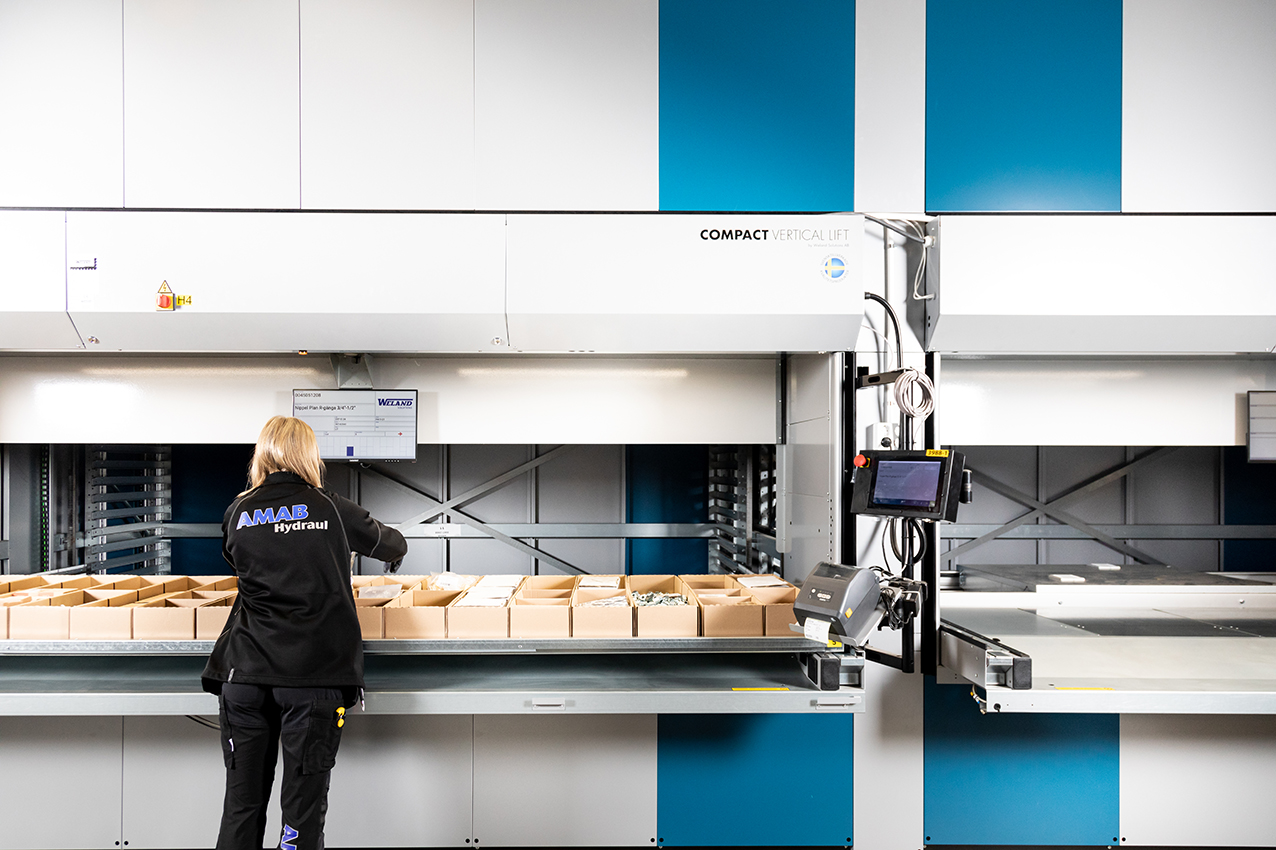
A Vertical Lift Module (VLM) is an enclosed, automated storage and retrieval system designed to maximize vertical space. It consists of two vertical racks of trays with an internal elevator (extractor) running between them. The system automatically retrieves and delivers specific trays to an operator at an ergonomic workstation.
For over 80 years, White Systems has engineered these systems to solve the “hidden” problem in most facilities: underutilized ceiling height. By moving inventory vertically, a VLM can reclaim up to 85% of your existing floor space.
VLM vs. Vertical Carousel: What’s the Difference?
While they look similar from the outside, the mechanics are very different:
-
Vertical Carousels: Function like a Ferris wheel; the entire set of shelves rotates to bring the item to you. This is ideal for consistent, small-part storage like in a [Hospital Pharmacy].
-
Vertical Lift Modules (VLM): Only the specific tray needed is moved by an internal elevator. This allows for much higher weight capacities and the ability to store items of varying heights within the same machine.
The Different Types of Vertical Lift Modules
As an Original Equipment Manufacturer (OEM) based in Ohio, White Systems provides a range of VLM technologies tailored to specific industrial needs.
1. The Compact Lift (Standard VLM)
The single-column, single-elevator VLM is the foundation of modern storage. It extracts one tray at a time and is the ideal entry point for facilities looking to eliminate walking and searching time.
2. The Compact Twin (Dual-Elevator VLM)
The Compact Twin uses a dual-staged elevator. While the operator is picking from one tray, the elevator is already fetching the next one behind the scenes.
-
The Result: Nearly double the throughput of a standard VLM, achieving over 100 tray presentations per hour.
3. The PowerColumn 3 (PC3) – Industrial Heavy-Duty
Designed and manufactured in the U.S. by White Systems, the PC3 is the “workhorse” of the VLM world. It is engineered for heavy industrial environments, offering high weight capacities and the rugged durability required for 24/7 manufacturing operations.
4. The Compact Double (Double-Deep VLM)
For facilities where floor space is at an absolute premium, the Compact Double offers the highest storage density. It stores trays two-deep (front and back), allowing for massive inventory volume within a tiny footprint.
How does a Vertical Lift Module work?
The elevator moves vertically to a specific “slot,” extracts the tray, and delivers it to the “Golden Zone”—an ergonomic picking window typically 37-40 inches high. This eliminates the need for ladders, reaching, or bending, significantly reducing workplace injuries.
Critical Features to Evaluate
VLM Drive Systems
Reliability depends on the drive. While some systems use belts or chains, Rack and Pinion systems (like those found in White Systems units) are particularly robust. They do not stretch over time and require significantly less maintenance than belt-driven alternatives.
VLM Software (The Brain)
Hardware is only as good as the software controlling it. Our proprietary MILO™ Software integrates directly with your WMS or ERP, enabling advanced features like:
-
Batch Picking: Picking multiple orders simultaneously.
-
Slotting Optimization: Automatically moving high-use trays closer to the access window (similar to defragmenting a hard drive).
Features to review when evaluating a VLM
VLM Drive Systems
One of the critical components of a VLM is the extractor drive system. The belt system, rack and pinion or gear system, or chain system drives a VLM machine. These vary in initial cost, reliability, maintainability, and life-cycle cost. Some systems use two points of contact for the tray load while others use a more stable 4 points construction.
VLMs that are built with rack and pinion drive and chain systems are particularly robust. Chain systems tend to be older and generate higher noise levels. The rack and pinion systems do not stretch and generally require less maintenance than belt drive systems.
VLM Software
Software is often a critical feature of any automated storage and retrieval system. The VLM software enables the various VLM capabilities, such as batch picking, storage optimization, and slotting optimization.
The VLM software should integrate smoothly and work with the existing Warehouse Management System (WMS) or Enterprise Resource Planning (ERP) system for maximum efficiency.
Start Optimizing with White Systems
Whether you need the rapid speed of a Compact Twin or the industrial power of a PC3, our team of experts—including 30+ direct-hire Field Service Engineers—is here to support your facility’s ROI for the long haul.
Ready to see the specs?
Explore Our Full VLM Product Line | Calculate Your ROI | Request a Consultation