

Vertical Lift Modules for Automated Parts Storage and Inventory Control
Save floor space, improve picking accuracy, and bring parts, tools, and inventory directly to the operator with White Systems Vertical Lift Modules. Our VLMs use high-density vertical storage, MILO™ software, and configurable tray layouts to help manufacturing, MRO, warehouse, healthcare, and defense teams control inventory in less floor space.
Customer Result: ABB Consolidates Storage with VLMs
“We eliminated over 500 storage bin locations. We’ve been able to use that space to maximize and optimize the production of our floor.”
— Warehouse Supervisor at ABB
Watch the ABB VLM in action

What Is a Vertical Lift Module?
A Vertical Lift Module, or VLM, is an automated vertical storage system that stores parts, tools, supplies, and inventory in high-density trays. An internal elevator retrieves the correct tray and delivers it to an ergonomic access opening, allowing operators to pick from a fixed goods-to-person workstation instead of walking aisles or searching through static shelving.
Also called an automated vertical lift module, vertical automated storage system, or VLM storage system, this type of equipment helps warehouses, manufacturers, MRO teams, and distribution operations store more inventory in less floor space while improving picking accuracy, inventory control, and retrieval speed.
How a VLM storage system works
A VLM stores trays vertically on both sides of an internal lift. When an operator requests an item, the system locates the tray, retrieves it automatically, and delivers it to the access opening.
With MILO™ software, each pick can be directed, verified, and updated in real time. Barcode scanning, user permissions, pick lists, and ERP/WMS integration help turn the VLM into a controlled inventory system, not just a storage machine.
For higher-throughput applications, the Compact Twin can stage the next tray while the operator works from the current tray, helping reduce wait time between picks.

See the Compact Twin VLM in action
VLM Inventory Management with MILO™ Software
White Systems VLMs do more than store inventory. With MILO™ software, barcode scanning, user permissions, and ERP/WMS integration, each system can help control how parts are stored, picked, replenished, counted, and tracked.
VLM inventory management can support:
- Real-time item location tracking
- Guided picking
- Barcode verification
- User-based access control
- Pick lists and batch picking
- Replenishment workflows
- Cycle counts
- Transaction history
- ERP, WMS, MRP, or MES integration
- Controlled access for high-value parts
This helps teams improve inventory visibility and accountability while reducing manual searching, handwritten logs, and inconsistent inventory processes.
Typical VLM Specifications
- Tray width: up to 3,000 mm / 118 in
- Tray depth: 820–860 mm / 32–34 in
- Load per tray: up to 1,000 lbs / 450 kg on standard configurations
- Machine height: 8–52 ft, depending on application and facility height
- Positioning accuracy: ±1 mm
- Cycle time: approximately 20–30 seconds per retrieval, depending on model and configuration
White Systems VLMs can include automatic height sensing, dynamic storage allocation, and industrial drive technology for smooth, consistent tray positioning across demanding workflows.
For heavy-duty applications, ask about Compact Heavy or PowerColumn 3 configurations.
Benefits of Vertical Lift Modules
Save floor space
Use unused ceiling height to consolidate shelving, bins, and storage areas into a smaller vertical footprint.
Improve picking speed
Bring trays directly to the operator to reduce walking, searching, and manual handling.
Improve inventory accuracy
Use guided picking, barcode verification, and MILO™ software to help operators pick the right item and update inventory records.
Support ergonomic picking
Deliver trays to an ergonomic access height to reduce bending, reaching, climbing, and unnecessary travel.
Control access to inventory
Use permissions and secure storage to help manage high-value, regulated, or mission-critical parts.
Scale around your operation
Configure tray sizes, load capacity, access points, and software workflows around your parts and throughput needs.
See a VLM installation in action

This time-lapse shows how unused ceiling height is converted into dense, organized storage — without expanding the building footprint.
Automated Parts Storage with VLMs
Vertical Lift Modules are often used when parts, tools, supplies, or high-SKU inventory have outgrown traditional shelving. Instead of spreading inventory across aisles, bins, cages, or scattered storage areas, a VLM keeps parts organized in high-density trays and delivers the right tray directly to the operator.
This makes VLM parts storage useful for operations dealing with crowded shelves, lost inventory, slow picking, limited floor space, or high-value items that need controlled access.
Common items stored in VLMs include:
- Spare parts
- Tools and tooling
- Maintenance supplies
- Electronic components
- Production parts
- Kitting materials
- High-value inventory
- Small parts and hardware
- Replacement components
- Controlled inventory
How VLMs Help Maximize Warehouse Space
White Systems VLMs use unused ceiling height to consolidate wide-aisle shelving, bins, and scattered storage locations into a compact automated storage system. This allows warehouses, manufacturers, and distribution centers to store more inventory in less floor space without expanding the building.
Typical space-saving opportunities include:
- Reclaiming 70–85% of floor space
- Reducing wide aisles and wasted air space
- Freeing space for production, staging, or growth
- Increasing storage density without a facility expansion
Still comparing VLMs to shelving? Read our VLM vs Static Shelving Guide.
Compare White Systems VLM Models
White Systems offers multiple Vertical Lift Module configurations for different storage, load, and throughput needs. Use this chart as a starting point to compare models by application, tray configuration, capacity, and software integration.


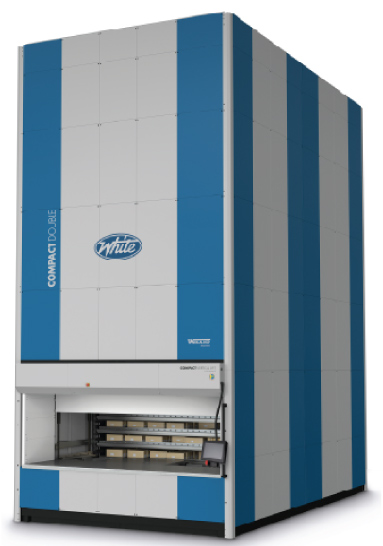
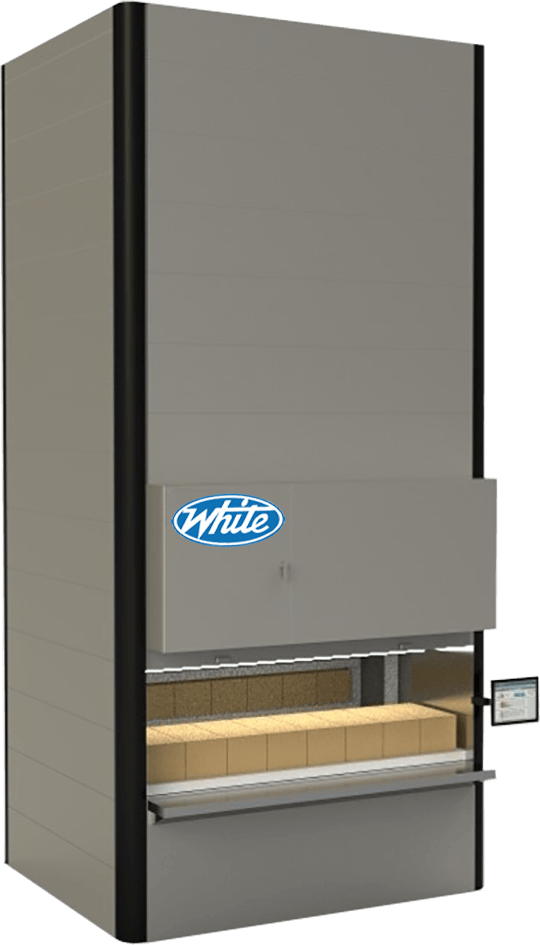
All White Systems VLM models use a 4-point metal rack-and-pinion drive system for precise, reliable tray positioning. This design helps reduce the stretching, slipping, and maintenance concerns associated with belt-driven systems.
Compact Lift VLM: Versatile Automated Vertical Storage
The Compact Lift is a versatile Vertical Lift Module for parts, tools, MRO supplies, kitting components, and general inventory storage. By using available ceiling height, the Compact Lift helps reclaim floor space while delivering items directly to an ergonomic picking station.
This model is a strong fit for teams that need reliable goods-to-person storage without the higher throughput requirements of a dual-staged system.
Compact Twin VLM: High-Throughput Picking
For high-volume picking and kitting operations, speed matters. The Compact Twin uses a dual-staged elevator to stage the next tray while the operator works from the current tray, helping reduce wait time at the access opening.
It is the fastest VLM option in the White Systems lineup for facilities where throughput and continuous picking are priorities.
Compact Double VLM: Maximum Storage Density
The Compact Double is designed for operations that need more storage density within a compact footprint. With a four-tray-per-level configuration, it can store more inventory vertically while maintaining goods-to-person access.
This model is a strong fit for facilities where floor space is limited and storage density is the primary goal.
PowerColumn 3 VLM: Heavy-Duty Storage for Large Parts and Tooling
The PowerColumn 3 (PC3), or PC3, is White Systems’ heavy-duty VLM platform for large, heavy, or demanding industrial storage applications. Its rack-and-pinion drive is engineered for durability, positioning accuracy, and reliable performance in manufacturing and maintenance environments.
With tray capacities up to 2,000 lbs, the PC3 is designed for heavy tools, dies, components, and other large inventory that requires controlled vertical storage.
Where VLMs are a good fit
Vertical Lift Modules are commonly used when teams need to reclaim floor space, speed up inventory access, improve picking accuracy, or control parts and supplies in a smaller footprint.
Manufacturing & MRO
Store production parts, spare parts, tools, and maintenance inventory near the point of use while reducing wasted floor space.
Warehousing & Fulfillment
Support high-SKU storage, faster picking, and better inventory control in space-constrained warehouse and distribution environments.
Healthcare & Pharmacy
Secure and organize medical supplies, pharmacy inventory, or controlled items where access, accuracy, and space utilization matter.
Aerospace, Defense & Government
Control high-value parts, tools, and mission-critical inventory with user permissions, transaction history, and secure storage.
Energy & Infrastructure
Keep critical utility parts secure, traceable, and ready for maintenance or rapid-response repairs.
General Inventory Storage
Organized, secure storage for a wide range of materials where floor space is limited and access matters.
National VLM Service and Lifecycle Support
A VLM is a long-term investment, and uptime matters. White Systems supports VLM installations through a national network of 30+ direct-hire, factory-trained Field Service Engineers.
Our team can support:
- Installation and startup
- MILO™ software integration
- Preventive maintenance
- Troubleshooting and repair
- Spare parts support
- Mid-life rebuilds and upgrades
- Long-term lifecycle service
Because our technicians are direct-hire White Systems service experts, customers receive support from teams trained on our equipment, software, and parts.
VLM Safety and Ergonomic Picking
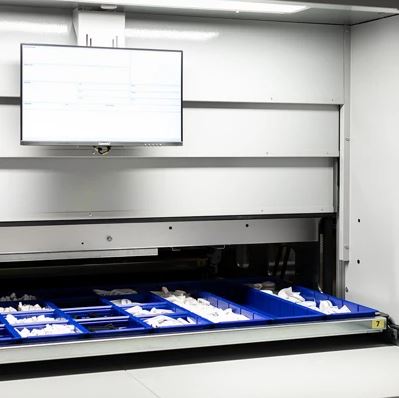
White Systems VLMs are designed to deliver trays to an ergonomic access height, reducing the bending, reaching, climbing, and walking often required with traditional shelving or storage racks.
Standard safety features can include:
- Full-height light curtains
- Automatic door interlocks
- Emergency stops
- Enclosed storage areas
- Ergonomic access openings
- User-based access control through MILO™ software
These features help protect operators while keeping inventory secure and accessible through a controlled goods-to-person workflow.
Vertical Lift Module FAQ
What is a vertical lift module?
A vertical lift module is an automated storage system that stores inventory in trays and uses an internal elevator to deliver the correct tray to an operator. VLMs are commonly used for parts, tools, MRO supplies, components, and high-SKU inventory.
What is the difference between a VLM and a vertical carousel?
A VLM stores trays in vertical columns and uses an extractor/elevator to retrieve the requested tray. A vertical carousel rotates carriers around a vertical loop. VLMs are often used when tray height flexibility, dense storage, and controlled parts storage are priorities, while vertical carousels can be a strong fit for certain repetitive picking or pharmacy-style applications.
How much floor space can a VLM save?
A VLM can often reclaim 70–85% of floor space by using unused ceiling height and consolidating inventory that was previously stored across shelving, bins, or aisles. Actual space savings depend on inventory size, facility height, tray configuration, and workflow.
What can be stored in a VLM?
Common VLM inventory includes spare parts, tools, tooling, MRO supplies, electronic components, production parts, kitting materials, hardware, replacement components, and controlled or high-value inventory.
How does a VLM improve picking accuracy?
A VLM can improve picking accuracy by delivering the correct tray to the operator and using software, barcode scanning, user permissions, pick lists, and inventory tracking to guide and verify each pick.
Can a VLM integrate with ERP or WMS software?
Yes. White Systems VLMs can integrate with ERP, WMS, MRP, or MES systems through MILO™ software, depending on the application and integration requirements.
How do I choose the right VLM model?
The right VLM depends on inventory size, tray load, available ceiling height, pick volume, throughput goals, access requirements, and software needs. White Systems can review your parts, facility layout, and workflow to recommend the best configuration.
Estimate Your VLM ROI
Use our ROI calculator to estimate potential space savings, productivity gains, and payback for your operation.
Ready to Find the Right VLM for Your Operation?
Whether you need to consolidate parts storage, improve picking accuracy, control high-value inventory, or reclaim floor space, White Systems can help configure a VLM around your facility, inventory, and workflow.
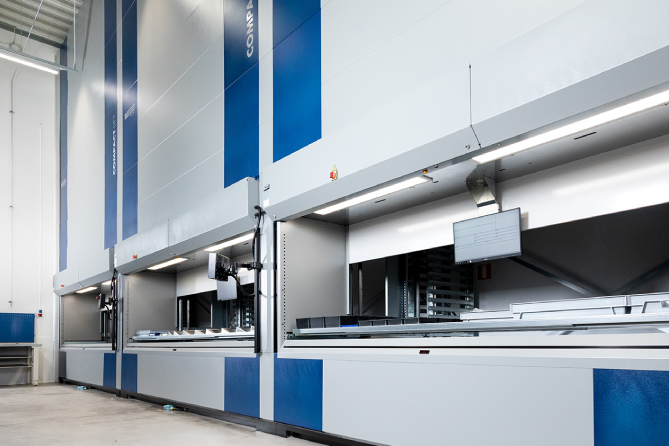
Ready to explore automated storage? Send us a message and our team will help you get started.
Talk to a Storage Expert
Ready to explore automated storage? Send us a message and our team will help you get started.
Customers rely on our automated storage solutions to reclaim space and drive measurable efficiency: